
Anyone can post a screenshot. The work is the sourcing, and the standard below is the entire product. It is written down so you can hold us to it.
Every item has two halves
They carry different requirements, deliberately. One rule applied to both would be either useless or unusable.
The advocacy half — what standard did they set for others?
Primary source required, without exception. Their own words, their own vote, their own signed order, their own press release. Not a report of it. The thing itself.
The conduct half — what did they actually do?
Any one of the following:
- Two independent credible reports from established outlets
- One credible report plus a primary document — a dated photograph, a filing, a disclosure, a record
- Primary evidence alone
Credible reporting is evidence. A named reporter at an established outlet who documented the conduct has done verification work we can rely on and cite. We are not required to re-report the news.
But the source must establish that the standard was actually in force at that time and place. If the reporting does not, we establish it ourselves or we do not publish. This is the most common way a conduct claim fails our review.
Claims that someone stayed silent
These require a documented search: which sources were checked, over what date range, and what was found. We write “we found no public comment.” We never write “they said nothing,” because the second is an absolute we cannot support.
If they break the silence later, that is a follow-up post stating the sequence. It is not an embarrassment.
The higher bar for Family B
Absurdity is judged through the observer’s assumptions in a way hypocrisy is not, so it carries three controls the other family does not need.
The full artifact, primary source, complete. The entire clip, the entire transcript passage, the entire filing. Reporting may point us to it. It never substitutes for it.
Full context is a stopping condition. We review the complete surrounding material, and if the fuller context makes it less damning, it does not run. Not with a caveat. Clipping is how anyone can be made to look foolish, and it is the fastest route to both a correction and a reputation we could not undo.
The swap test, weighted double. If we would not run it against the other party, we do not run it at all.
If it needs explaining, it isn’t there. An item that requires us to argue why it’s clownish is an opinion piece, not a receipt.
What we will not do
- No motive asserted without documentation. We show what happened and when. We do not claim why unless a primary source says why. “The position reversed after the majority did” is a documented sequence. “They reversed because of donors” is an accusation requiring its own proof.
- No accusation of a crime without a filing, a charge, or sworn testimony.
- No private citizens, no junior staff. Public officials and declared candidates only.
- Personal conduct is out of scope unless the person advocated the standard they broke. The advocacy is what makes it public business.
- We never mock how someone speaks. Stumbles, misspeaking, mixed-up names, lost words. That is how humans talk, it tracks with age and disability, and it is off limits permanently. What someone says can be absurd. How it came out of their mouth is not our subject.
- Being wrong is not buffoonery. Everyone is wrong about things. Confidently legislating on a subject one demonstrably does not understand is a different matter, and the post has to make that distinction visible.
Confidence below our threshold never publishes. Not with a hedge, not with a caveat.
Evidence and verdict never mix
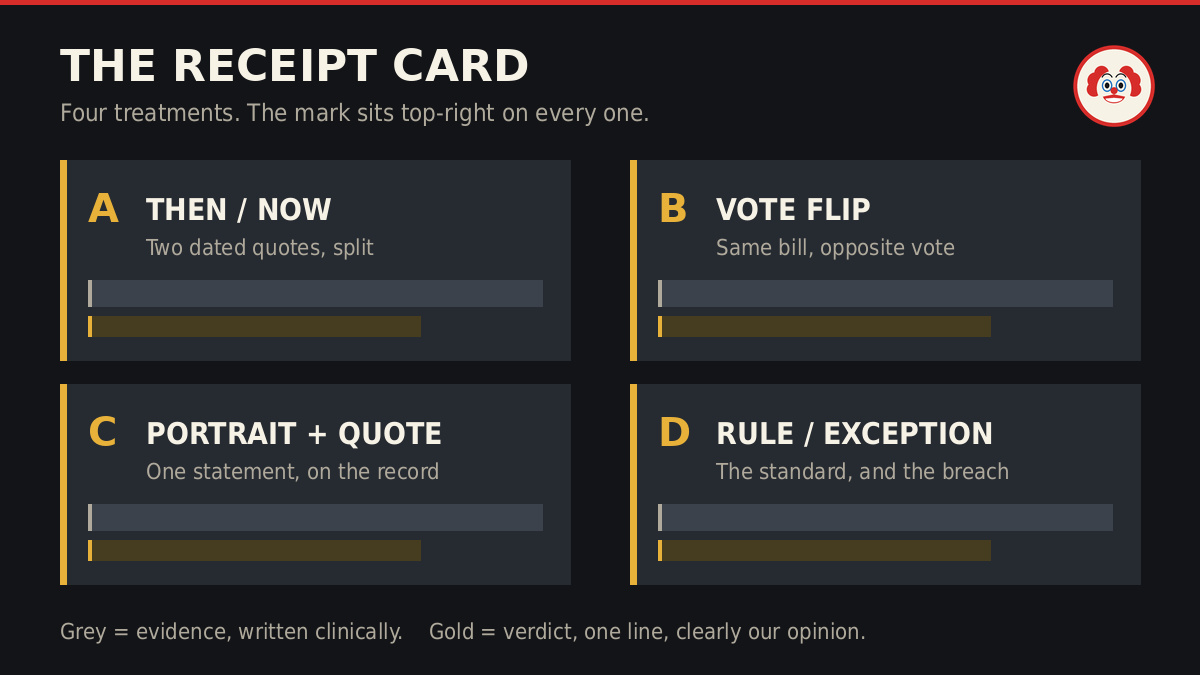
Every post has two zones, and they are physically separate on the page and on the card.
The evidence zone is clinical. Quotes, dates, votes, sources, no adjectives. If someone from the subject’s own party read only this zone, they should find nothing to object to.
The verdict zone is one line, set apart in gold. That is our opinion, it is allowed to be sharp, and it is clearly marked as ours.
The separation is not decoration. It is what lets you tell what we proved from what we think.
The standing principle
Rejecting a story costs us nothing. There is always another one.
A published error costs the credibility this entire thing is built on, and for a site whose premise is holding people to their own words, that is the only asset that matters.
When in doubt, we don’t.